Sub-agents
The sub-agent tool enables your agent to delegate specialized tasks to existing
agents, reducing load and context bloat in the main agent. Think of sub-agents
as isolated domain experts that the parent agent can invoke independently for
specific tasks. A sub-agent is a reference to another agent by its agent_key.
You create those agents first, and then add them as sub-agents.
This approach is especially useful when tasks require distinct expertise or when a single agent becomes too complex. When you add a sub-agent, you define its purpose in the sub-agent tool description, or in the main agent instructions. The main agent passes input to the sub-agent, which can access all files and artifacts available to the parent agent.
Each sub-agent maintains its own tools, instructions, and conversation history, allowing it to complete tasks independently before returning results to the main agent.
Use sub-agents when tasks benefit from specialized instructions and tools. For example, a document processing system might delegate legal review, technical accuracy checks, and content reformatting to separate sub-agents, since each task requires different expertise.
Try our Sub-agents Jupyter notebook for a hands-on example. Build a research assistant with three specialized sub-agents, including API validation to prevent common errors.
Agent key
The agent_key uniquely identifies an agent. A parent agent needs this value to
reference and invoke specific agents as subagents. You can get the
agent_key from the Agents List (UI)
or the List Agents endpoint (API).
How sub-agents work
When a parent agent invokes a sub_agent tool:
- The sub-agent tool creates a new session, or resumes a previous one using a
session_key. - The sub-agent tool calls the referenced agent (identified by
agent_key) with the input message:- The sub-agent processes this request using its own instructions, tools, and memory.
- The sub-agent can only access its own tools.
- The parent agent cannot access the sub-agent's tools.
- The sub-agent tool returns the
session_keyandsub_agent_response(the sub-agent's final output) to the parent agent.
For more information about sub-agents architecture and how they work, see our blog.
- The sub-agent tool always returns only the final response of the sub-agent. Activity inside the sub-agent is not returned to the parent agent. Ensure that you write sub-agent instructions so that the final message is self-contained.
- Sub-agents operate in isolated workspaces. They do not share memory, history, or tool state with the parent unless configured with artifact sharing.
Add a sub-agent with the UI
The easiest way to add a subagent is with the UI when you create or update an agent.
- In the agent creation wizard, go to the Tools tab.
- Click Add tool.
- Find the Sub Agent tool in the list.
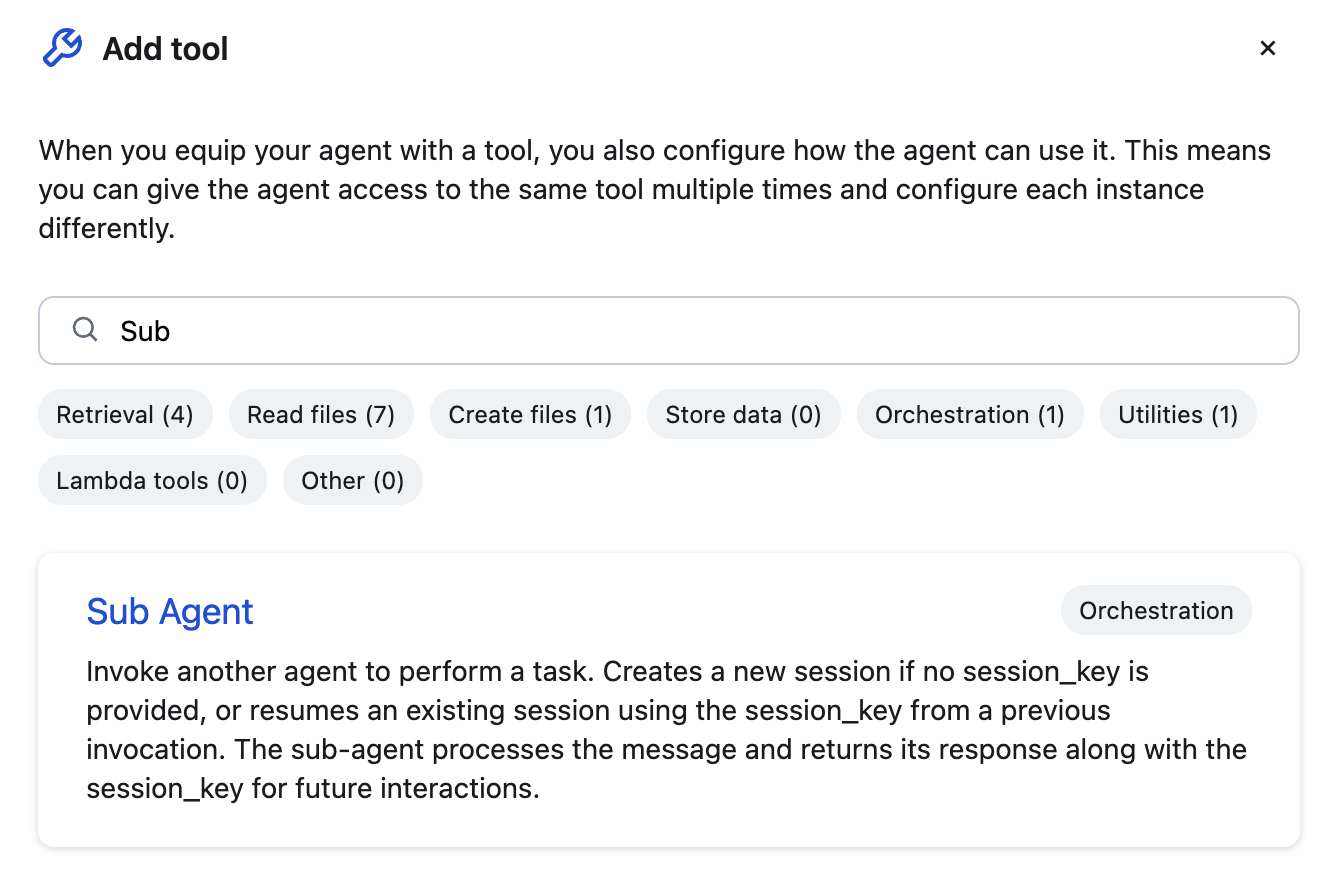
- Enter a name for your sub agent, add a description, and enter the
agent_key. You can get this value from the Agents List (UI).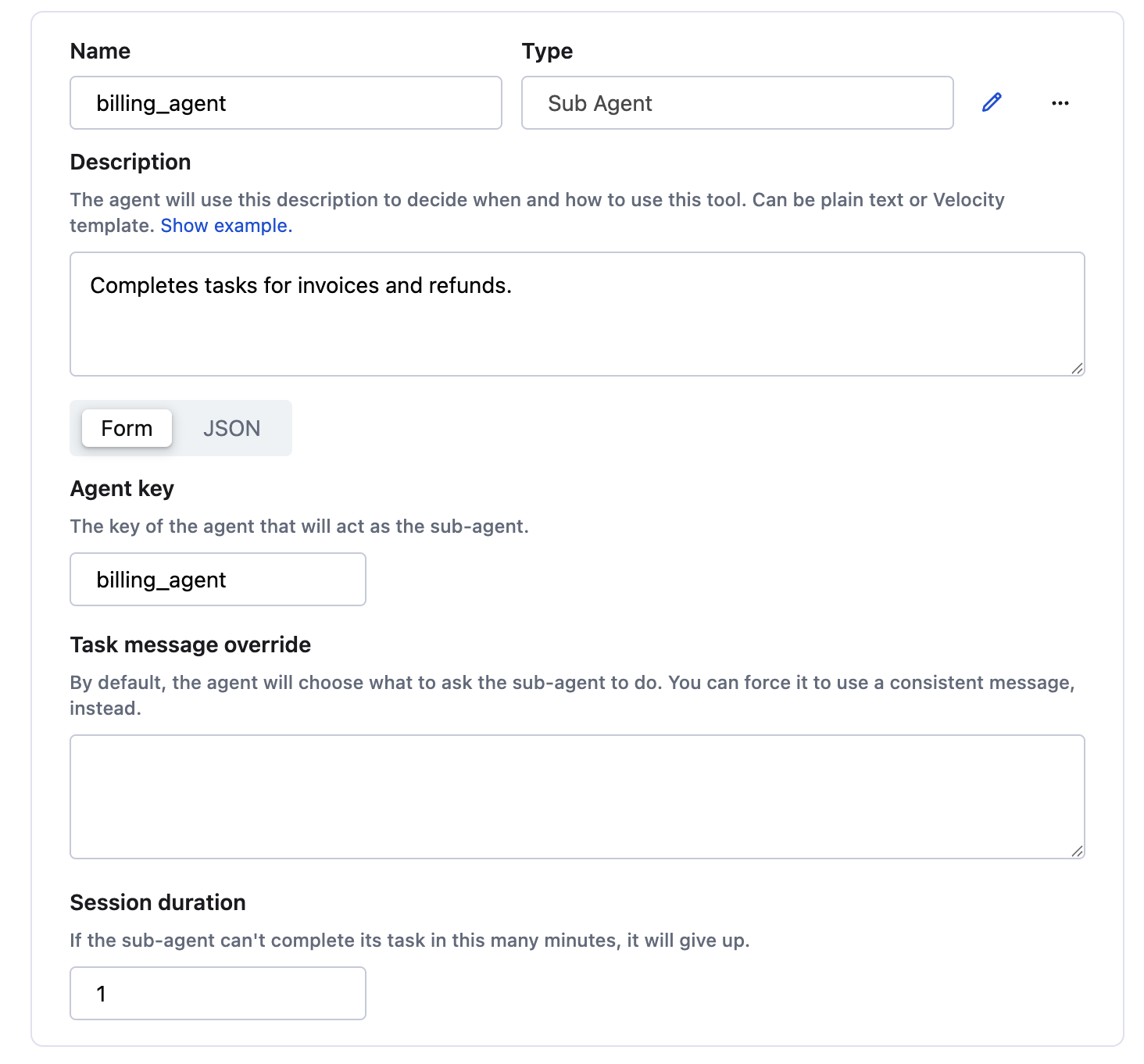
- Click Update agent.
Configure a sub-agent tool
You can also configure the sub-agent tool inline with the API. The
configuration defines which agent to invoke (agent_key), optional session
behavior, and optional argument_override. You can get the agent_key value from
the List Agents endpoint (API).
argument_override lets you hardcode values for fields exposed to the LLM of the
sub-agent tool (message and session_tti_minutes). The LLM cannot modify
overridden fields or see the values that were supplied.
You can also use dynamic references inside argument_override. These values are
resolved at runtime using $ref syntax and can read from:
session.metadata.*agent.metadata.*agent.secrets.*— encrypted, masked values managed under Agent secrets.
Session modes
The sub-agent tool supports three session modes that control whether sessions are resumed or created fresh each time:
llm_controlled: (Default) The model decides when to resume a previous session or start a new one.
If the LLM provides asession_key, the session resumes. If not, a new session starts.persistent: The sub-agent tool always reuses the same session created on first invocation.
Use this for agents that build knowledge across multiple invocations, such as research or iterative drafting workflows.ephemeral: The sub-agent tool always starts fresh. Each call creates a new session.
Use this when you want strict isolation and do not want state to carry across invocations.
Invoke a sub-agent
After configuring a sub-agent tool, the parent agent can invoke it by passing a
task message. The sub-agent tool then calls the referenced sub-agent with this
message. The message field is exposed to the LLM and defines the specific
task the sub-agent must perform.
Session management
The sub-agent tool maintains sessions for sub-agents across invocations using
a session_key.
- If the parent agent does not provide a
session_key, the sub-agent tool creates a new session. - If the parent agent retains the
session_keyof the sub-agent, the sub-agent tool resumes that session.
Sub-agent sessions are owned by the parent agent. No other agent can access them. If a parent attempts to resume a session it did not create, the request is rejected.
Artifact sharing
Parent agents can share artifacts with sub-agents through the sub-agent tool.
The sub-agent tool passes the artifact to the sub-agent's workspace using the
artifact_id.
The parent must own the artifact before sharing it. If the artifact does not exist in the parent’s workspace, the system returns an error.
Sub-agent patterns
Single task: Use when tasks do not require any context to carry over.
SINGLE TASK
Code example with json syntax.1
Persistent sub-agent sessions: When when tasks have multiple steps, such as iterative reviews or content generation.
PERSISTENT SUB-AGENT SESSIONS
Code example with json syntax.1
Multiple specialized sub-agents: Assign different sub-agents for a variety of tasks.
MULTIPLE SPECIALIZED SUB-AGENTS
Code example with json syntax.1
Example: Inline code review sub-agent
INLINE CODE REVIEW SUB-AGENT
Code example with curl syntax.1